What is Happening to the Person I Love?
A Guide for Those Who Witnessed an Expansion Event
You just watched someone you care about go through something that frightened you.
Maybe they were in intense distress. Maybe they couldn’t speak clearly. Maybe they said things that alarmed you, or cycled between suffering and an unusual calm that didn’t make sense. Maybe doctors couldn’t explain it, or you chose not to go to a doctor because something told you this was different.
Now they are stable, or at least more stable, and you are left trying to make sense of what you witnessed.
You may be asking:
Are they okay?
Is this going to happen again?
Should I have done something differently?
Is this a mental health crisis?
What is actually happening to them?
Am I supposed to believe this is normal?
This guide is for you. Not for the person going through it, but for you, the one who watched, who stayed, who is now processing what they saw.
First: Your Response Is Valid
Whatever you felt while witnessing this, whether fear, confusion, helplessness, disbelief, or even a strange sense that something significant was happening, all of it is a valid response to an unusual experience.
You were not prepared for this. There is no cultural script for watching someone you love move through something that medicine cannot fully explain, and that doesn’t fit any framework you were given.
Being shaken by it makes complete sense.
Give yourself permission to process your own experience before trying to understand theirs. You cannot pour from an empty vessel, and you cannot support someone else’s integration while your own nervous system is still in shock.
What Actually Happened
What you witnessed might be what is called an Expansion: a rapid shift in a person’s awareness, perception, and physical calibration that produces intense symptoms across the body, mind, and emotions.
Think of it as the human system suddenly receiving more signals than it is accustomed to processing. The physical and emotional symptoms are the body’s response to that rapid recalibration. Instead of signs of breakdown, these are signs of a significant upgrade in capabilities.
This is not a metaphor. The symptoms are real. The distress is real. And the process is purposeful.
What you witnessed was a breakthrough, even though it might have looked like a breakdown.
Making Sense of What You Saw
Some of what you witnessed may have been particularly difficult to watch. Here is some context for the most common and alarming aspects:
The Intense Physical Symptoms:
Energy surges, pressure in the stomach or throat, nausea, vomiting, trembling, and difficulty speaking are all documented responses to rapid energetic recalibration. The physical body is deeply connected to energetic processes, and when those processes are intense, the body responds physically.
Physical purging, particularly vomiting and diarrhea, often brings immediate relief from energetic pressure. It is the body completing a release initiated by the energetic system. If you witnessed this and it looked like distress followed by sudden calm, that is exactly what was happening.
The Cycling Between Distress and Unusual Calm:
If the person you were with seemed to alternate between intense suffering and moments of unexpected peace, serenity, or even humor, this is a recognized pattern of Expansion events.
The moments of calm are not dissociation or denial. They are brief windows into the expanded state: glimpses of a new baseline emerging as the process unfolds. What looked like a “different person” in those moments may actually be more of who they truly are.
If They Couldn’t Speak Clearly:
Temporary difficulty with expressive speech, while comprehension remains intact, can occur during intense Expansion phases. The system temporarily redirects resources away from expression and toward integration. It resolves as the intensity passes and does not indicate neurological damage.
If They Said Frightening Things:
Expressions of wanting to escape, wanting out, or not being able to bear the intensity are common at peak Expansion experiences. They are almost always the intensity speaking, rather than genuine statements of intent.
The distinction that matters is whether these expressions appeared during peak physical and energetic intensity and resolved as the intensity resolved. If they did, they were the body’s way of communicating “this is too much right now” — not a signal of genuine crisis. If these expressions continue after the acute phase has fully passed, that warrants different attention.
If The Calm You Feel Doesn’t Make Sense:
Some witnesses describe a strange sense of calm themselves during the event, an intuitive knowing that, despite appearances, the person was okay. If you experienced this, trust it. Human beings have an innate capacity to sense what is actually happening beneath the surface of events. That quiet knowing is valid data.
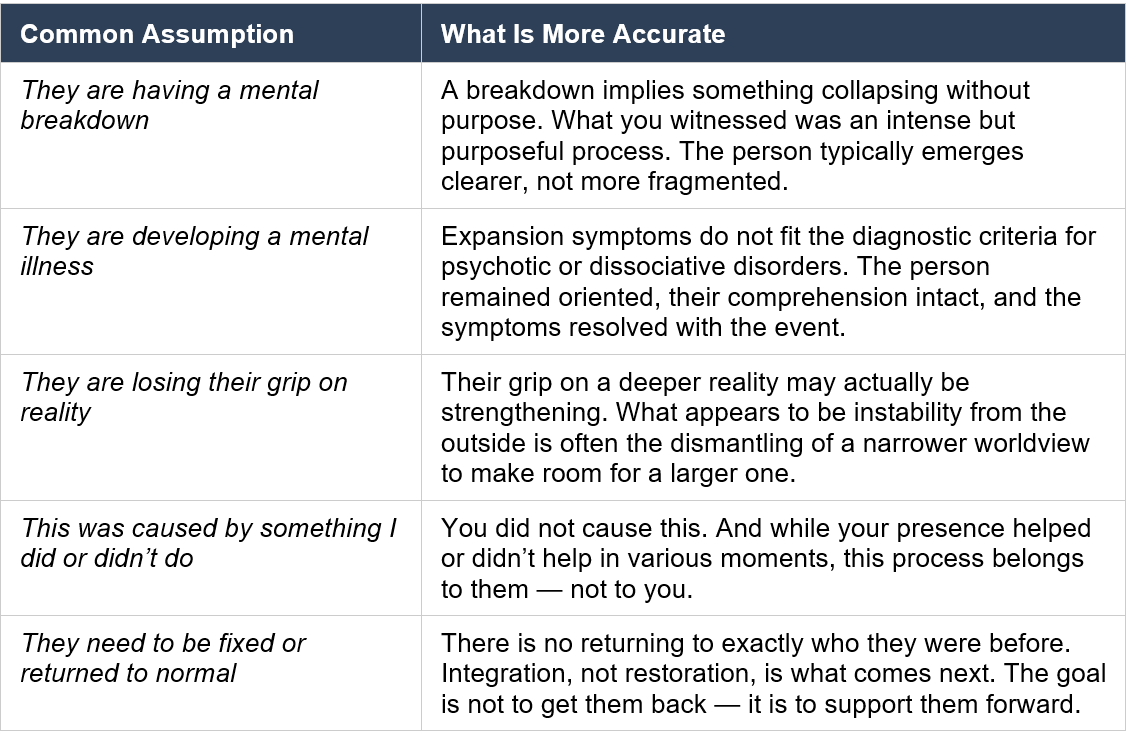
What This Is Not
It is natural to reach for familiar frameworks to explain what you witnessed. Here is honest guidance on the most common ones:
What Happens Now For Them
In the days following an Expansion event, the person you love will be in an integration phase. Their system is settling into a new baseline, and that takes time.
You might notice:
They need more rest than usual, sometimes significantly more
Their appetite may be reduced or shifted toward simpler foods
They may seem quieter, more inward, or less engaged with ordinary concerns
They may seem different in ways you can’t fully name, more settled, more present, or unexpectedly calm
They may want to talk about what happened, or may need time before they can
They may have increased sensitivity to noise, people, or busy environments
All of this is normal integration. The most supportive thing you can do during this period is provide and hold space: reduce demands, maintain calm in the environment, and follow their lead on when and how much to engage.
What Happens Now For You
Witnessing something you do not have a framework for is its own form of disorientation. You may be experiencing some version of what is sometimes called ontological shock, which is the destabilization that comes when reality does not behave the way you expected it to.
Common responses include:
Replaying what you witnessed and trying to make sense of it
Alternating between wanting to understand and wanting to dismiss it entirely
Feeling protective of the person and unsure how to help
Worry about whether this will happen again and whether you can handle it
A quiet sense that something has shifted, whether in them, in you, or in your understanding of what is possible
These responses are signs that you witnessed something real and significant, and your mind is doing the work of integrating it. There is nothing wrong with you for feeling any of these things.
Regulating Your Own Nervous System
If you are still feeling activated (anxious, unsettled, or unable to fully relax), your nervous system is still processing what it experienced. Here are simple tools:
Slow your breathing deliberately. Longer exhales than inhales. This directly activates the parasympathetic nervous system.
Move your body. A walk, even a short one, helps discharge the activation that witnessing intensity can create.
Talk to someone you trust about what you experienced, not to explain or justify it, just to give it voice.
Resist the urge to immediately research or find explanations. Your nervous system needs to settle before your mind can process clearly.
Give yourself permission to not have answers yet. Understanding comes after settling, not before.
The Harder Questions
“Are they going to be okay?”
In most cases, yes, and often more than okay. People who have been through Expansion events typically describe emerging with greater clarity, stronger intuition, and a deeper sense of who they are. The acute phase is intense but temporary. What comes after tends to be an expansion of capacity, not a reduction of it.
“Is this going to happen again?”
It may. Expansion tends to happen in waves over time rather than as a single event. However, each subsequent experience is typically navigated with more ease because the person now has reference points they did not have before. They know what it feels like, that it passes, and that they can move through it.
“Should I have called for medical help?”
If the person is now stable and the symptoms have resolved or are resolving, the immediate moment has passed. Going forward, the guidance is to hold both possibilities simultaneously, medical and energetic, and act on genuine medical red flags if they appear. You did not fail by staying present and holding space. That was the right instinct.
“What do I do if I can’t accept this framework?”
You are not required to accept any particular explanation for what happened. What matters most is that you remain present and non-judgmental with the person going through it. You do not have to understand it to support them. You just have to care about them, and you clearly do, or you would not be reading this.
How to Support Them Going Forward
Follow their lead. Let them set the pace for conversation about what happened and what it means.
Listen without trying to explain or fix. “That sounds like it was really intense. I’m glad you’re okay.” is often enough.
Do not pressure them to return to normal quickly. Integration takes the time it takes.
If they share their experience or their emerging understanding with you, receive it with curiosity rather than alarm or dismissal.
Maintain ordinary rhythms in the home environment. Predictability and calm are stabilizing during integration.
Take care of practical needs without making a production of it. Simple acts of care, such as food, water, and quiet space, all communicate safety.
Check in gently over the following days. A simple “how are you feeling today?” matters.
Be honest about your own experience if they ask. You witnessed something significant too, and authenticity on both sides builds trust.
You stayed.
When something unfamiliar and frightening was happening to someone you love, you stayed present.
That is not a small thing. That is everything.
