How to Support Someone Through an Expansion Event
A Practical Guide for Caregivers, Family Members, and Supporters
Someone you care about is going through something unfamiliar and intense. They may be frightened, struggling to communicate, physically unwell, or cycling between distress and unexpected calm. You want to help, but you are not sure how. If that sounds familiar, this guide is for you.
What they might be experiencing is called an Expansion: a rapid shift in awareness, perception, and physical calibration that can produce intense symptoms across the body, mind, and emotions. It is real, it is purposeful, and it will pass.
Your role is not to fix it. Your role is to be a stable, steady presence while it moves through them. That is more powerful than any intervention, and you can do it right now.
The Most Important Thing to Understand
Presence is the intervention.
In supporting someone through an acute Expansion event, the single most effective thing you have is your calm, regulated presence. Not words. Not protocols. Not fixing. Simply being near them in a settled, unhurried state.
Human nervous systems are designed to co-regulate. When you are genuinely calm, the person you are with can begin to attune to that calm. Your steadiness becomes a resource they can draw on when their own system is overwhelmed.
This means that regulating yourself is the primary consideration. The more grounded you are, the more you can offer.
What to Do: Phase by Phase
When It First Begins:
Stay calm. Your initial response sets the tone. If you react with alarm, they will mirror that alarm.
Acknowledge what they are feeling without minimizing or over-explaining. “I can see this is intense. I’m here with you.”
Help them sit or lie down in a comfortable, safe space.
Remove unnecessary stimulation. Turn off screens, reduce noise, and dim lighting if helpful.
Do not immediately reach for your phone to search their symptoms. Your presence matters more right now than information.
Keep your voice low, slow, and steady. This communicates safety to their nervous system, even if they cannot fully process your words.
During Peak Intensity:
This is when your steadiness matters most. They may be in significant distress, struggling to communicate, or saying things that frighten you. Here is what to focus on:
Breathe slowly and audibly. Invite them to match your breathing without demanding it. “Breath with me — in slowly, and out slowly.”
If they can tolerate touch, a calm hand on their back or holding their hand is genuinely regulating. Ask first, and follow their lead.
Repeat simple reassurances quietly: “This will pass.” “Your body knows what to do.” “You are safe.” “I’m right here.”
Do not try to talk them out of what they are feeling or offer explanations in the middle of it. Save analysis for later.
If they vomit or have a physical purging response, stay calm and matter-of-fact. Help them clean up without drama. Physical purging often brings significant relief.
Do not leave them alone during peak intensity unless they specifically ask for solitude and you are confident they are safe.
Watch for genuine medical red flags. See the section below on when to seek medical care.
During Lulls and Between Waves:
Expansion events often move in waves rather than as a single sustained experience. The lulls between waves are important, so use them wisely.
Offer water. Hydration is genuinely important and gives them something simple and grounding to do.
Offer a warm cloth or warm compress if they have physical discomfort in a specific area.
Encourage slow, deliberate breathing during the lull to build resources for the next wave.
Acknowledge what they are managing: “You handled that well. You came through it.” Building their confidence in their own capacity matters.
Keep the environment quiet and calm. Resist the urge to fill the silence with conversation.
Provide light food when they are ready, something simple. Do not push food during active intensity.
Let them set the pace for any conversation. Follow their lead.
As Things Settle:
Continue gentle presence without pressure to return to normal.
Allow rest without an agenda. They may sleep for extended periods. This is integration, not illness.
When they are ready to talk, listen more than you speak.
Validate the reality of what they experienced without needing to label or explain it definitively.
Help with practical needs, including food, water, and comfortable surroundings, without taking over.
Check in gently over the following days. Integration continues after the acute phase.
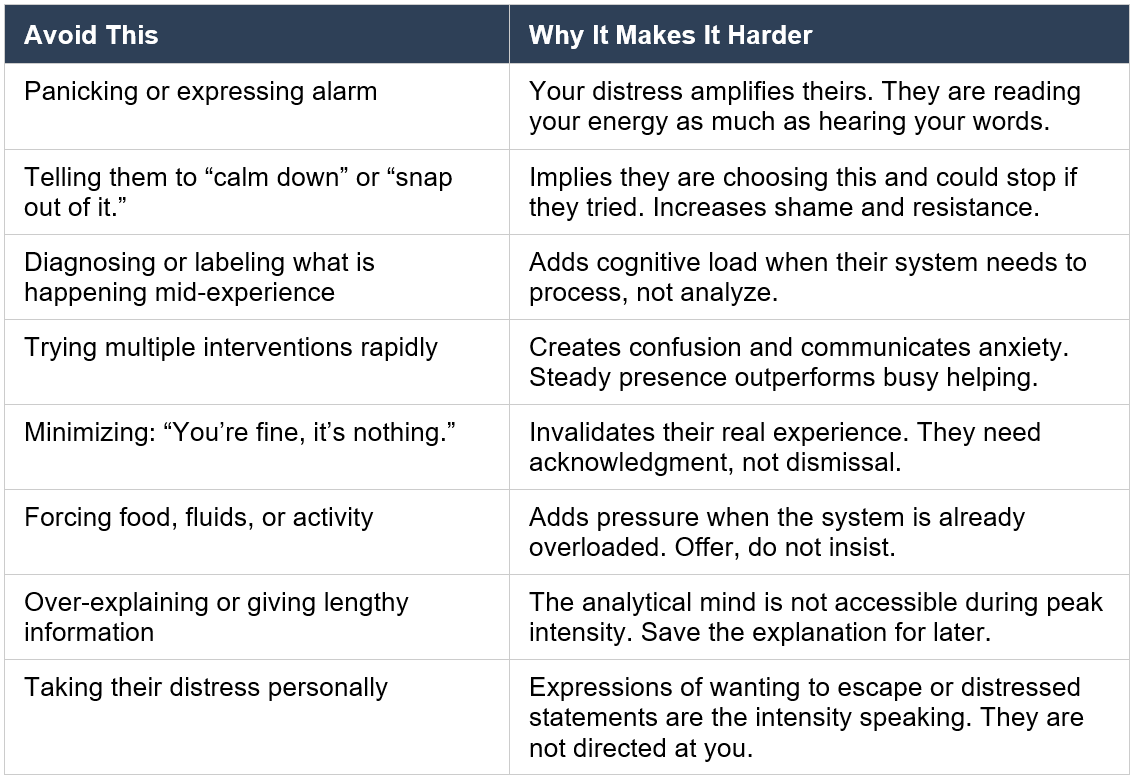
What Does Not Help
With the best intentions, supporters sometimes do things that make the experience harder. Being aware of these patterns allows you to avoid them.
Specific Situations
If They Say They Want to Escape or ‘Get Out’:
At peak intensity, it is not uncommon for someone to express that they want out: out of their body, out of the experience, or out of life. This is almost always the intensity of what they are feeling speaking, not a genuine desire for self-harm.
Stay calm. Do not react with alarm, which will amplify their distress. Stay close, keep your voice steady, and continue offering presence and reassurance that it will pass.
If these expressions continue after the acute phase has passed, or if there is any genuine indication of intent to self-harm, treat this as a medical and psychological concern and seek appropriate support immediately.
If They Cannot Speak Clearly:
Some people temporarily lose easy access to expressive speech during intense Expansion phases while retaining full comprehension. If this happens:
Do not ask open-ended questions that require complex verbal responses.
Use simple yes/no questions: “Are you okay right now?” “Do you want water?” “Do you want me to stay close?”
Reassure them that they do not need to speak. Their comprehension is intact, and that is enough.
This passes as the intensity reduces. Do not treat it as an emergency in itself.
If They Have Intrusive or Disturbing Thoughts:
Expanding perception can temporarily make someone more receptive to thoughts that feel foreign, aggressive, or completely unlike them. This can be frightening to witness and experience.
If they share these thoughts with you, respond with calm acknowledgment rather than alarm: “Thank you for telling me. Those thoughts are not you. They’re part of what’s moving through right now.”
Help them return attention to their breath and body rather than engaging with the content of the thoughts. The goal is not to analyze the thoughts but to help them unhook from them.
If It Is a Child:
Supporting a child through an Expansion event requires additional care. Children do not have the cognitive framework to contextualize unusual experiences, which means their fear response may be more acute.
Physical closeness and calm tone matter even more than words. Sit with them, hold their hand if they allow it, stay steady.
Use simple, age-appropriate language: “Your body is doing something new and it feels strange. It will pass. I’m right here.”
Do not over-explain. Simple reassurance repeated calmly is more effective than lengthy explanation.
Watch carefully for genuine medical symptoms. Children warrant a lower threshold for seeking medical evaluation.
After the event, help them process what happened in simple, positive terms: “You handled something really hard today. You were so brave.”
Reinforce that what they experienced was not dangerous and did not last forever. Building their confidence for future experiences matters.
When to Seek Medical Care
Expansion symptoms and physical illness can occur simultaneously. Holding both possibilities simultaneously is the responsible approach. Seek immediate medical evaluation if you observe:
Severe localized pain, particularly pain concentrated in one specific area
High fever (above 38.5°C / 101°F)
Difficulty breathing beyond normal panic or extreme stress response sensations
Loss of consciousness or near-fainting
Sustained vomiting without any periods of relief
Genuine expressions of intent to self-harm (distinct from distressed expressions of wanting the intensity to stop)
Symptoms that continue escalating without any waves of relief over several hours
Any symptom that your gut tells you requires medical attention
Seeking medical care does not invalidate what is happening at an energetic level. Both things can be true simultaneously. Caring for the physical body is part of supporting the whole person.
Taking Care of Yourself
Supporting someone through an intense experience is demanding, especially if you are not expecting it. Your own regulation is critical and forms the foundation for supporting others. Here are some specific strategies to help you be a better helper for others:
Compassionate Detachment:
Compassionate detachment is the practice of remaining fully present and caring without taking on the other person’s distress. It is your ability to hold steady while someone you care about moves through intensity.
Think of it this way: a lifeguard cannot save a drowning person by jumping in and drowning alongside them. You are most useful when you remain steady on the shore, reaching in with full care and full presence.
Regulating Yourself in Real Time:
If you feel your own anxiety or distress rising while supporting:
Take slow, deliberate breaths without making it obvious. Your breathing regulates your nervous system.
Plant your feet firmly on the floor. Feel the ground beneath you.
Remind yourself: “This is not my experience to fix. My role is to be steady.”
Step away briefly if needed, even thirty seconds in another room to breathe, and return.
Do not suppress your emotions; find the right time and space for them. During the acute phase is not the right time.
After It Has Passed:
Allow yourself to decompress. What you witnessed and held space for was real and intense.
Talk to someone you trust about your own experience as a supporter if needed.
Rest. You have also been working, even if in a different way.
Acknowledge yourself for showing up. Steady presence through difficulty is not nothing.
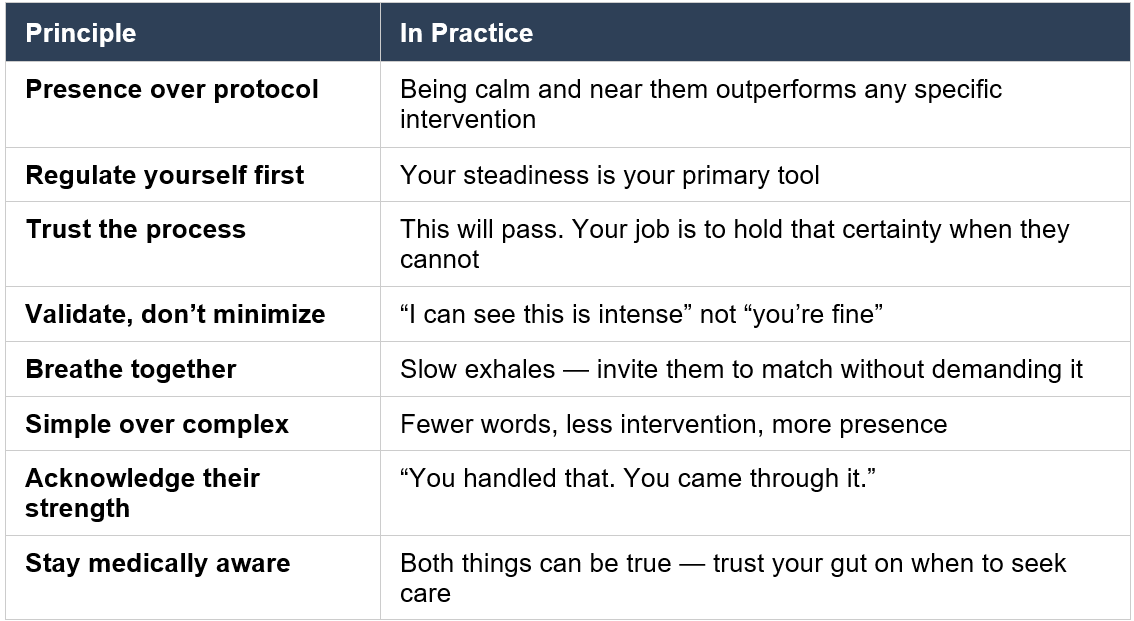
Quick Reference Card
When you don’t know what to do, return to these:
You do not need to understand everything that is happening.
You only need to be steady, present, and trusting that it will pass.
That is enough. It is more than enough.
