For When You Are in Active Distress from Expansion
Your First 24 Hours
A Simple Guide for When Everything Feels Like Too Much
Read this first:
You are not broken. You are not losing your mind. You are not having a medical emergency. However, if you have potentially life-threatening symptoms, don’t hesitate to seek medical care, such as an extremely high fever, severe localized pain, or genuine difficulty breathing.
What you are potentially experiencing is an Expansion: a rapid shift in your awareness and physical calibration that feels overwhelming because it is intense and unfamiliar.
You do not need to understand it right now. You only need to move through the next few hours. This guide will help you do that.
Right Now at This Moment
Do these things in order:
Stop moving. Sit down or lie down. Do not try to push through or maintain normal activity.
Breathe. Inhale slowly for 4 counts. Hold for 1. Exhale for 6 to 8 counts. Do this 5 times. Then again. Your breath is your most immediate tool.
Say this out loud or in your mind: “This is not a threat. My body knows what to do. This will pass.” Say it even if you do not fully believe it yet.
Place your hand on the area of most discomfort. Stomach, chest, or throat. Warmth and gentle pressure help. You are not trying to fix anything — just acknowledging where you are.
Let someone know. If there is anyone nearby, tell them simply: “I’m not okay right now. I need you to stay with me.” You do not need to explain more than that.
During the Intense Waves
This will move in waves. Intense periods followed by lulls. The waves might seem like they will not end. They will.
When it peaks:
Stop trying to think your way through it. The analytical mind is not helpful right now.
Focus only on your breath. Slow exhales. Keep returning to the exhale.
If you feel physical pressure or pain in your stomach or throat, breathe downward. Imagine the pressure draining down through your legs and out through your feet with each exhale.
If you feel the urge to purge physically, allow it. Do not fight nausea or vomiting. A physical release often brings immediate relief from energetic pressure.
If frightening thoughts arise that feel completely unlike you, do not engage with them. Name them: “That is not mine.” Return to your breath.
If you feel an overwhelming urge to escape, stay with your body. Plant your feet. Feel the ground. You are here. You are safe. You will be okay.
If you cannot form words easily, that is temporary. You do not need to speak. Nod or gesture if you need to communicate.
Between Waves: Use the Lulls
When the intensity drops, even briefly, use that window to build your resources for the next wave.
Drink water. Small sips. Your system is working hard and needs hydration.
Breathe slowly and build your calm during the lull, rather than passively waiting for the next wave.
If you can, go outside briefly or open a window. Fresh air and nature are genuinely grounding.
Hold something physical and solid: a stone, a piece of wood, anything that connects you to the physical world.
Rest lying down if you can. Do not fight the urge to sleep because sleep is integration.
Do not eat a large meal. Small amounts of simple food if you feel hungry, but nothing heavy.
Turn off screens, news, and social media. Your system needs quiet input right now.
Remind yourself: “I handled the last wave. I will handle the next one.” Each wave you move through builds your confidence for the next.
Grounding Protocol to Use Anytime
Use this during lulls or whenever you feel too unmoored. It takes 3 to 5 minutes and becomes more effective with repetition.
Sit or lie down. Close your eyes if it feels safe to do so.
Breathe slowly. Let your body settle slightly before continuing.
Imagine a line of light or warmth extending downward from your feet into the earth. It does not matter if you can feel it; the intention is enough.
With each exhale, imagine anything heavy, fearful, or uncomfortable flowing down through that line and releasing into the ground.
When you feel slightly lighter, imagine steady, calm energy flowing downward from above, through the top of your head, and into your chest.
Stay with this for as long as it feels right.
When complete, take three slow breaths, open your eyes, and do something physically grounding: drink water, touch the floor with your bare feet, or hold something solid.
Emergency breathing for anytime, anywhere: Inhale 4 counts. Hold 1. Exhale 6 to 8 counts. The long exhale activates your body’s calming response. Repeat until you feel the shift.
What Is Happening and Why
You do not need to fully understand this right now. But having a basic frame of reference can reduce the fear, and reduced fear makes everything more manageable.
Your awareness is expanding. Your physical and energetic systems are recalibrating rapidly to accommodate a wider range of perception and experience. The symptoms you are feeling are the body’s response to that process, similar to how muscles are sore after intense exercise, or how a phone heats up when running a major software update.
Everything surfacing, the emotions, the physical sensations, the strange thoughts, was already present within you. The Expansion is not creating new problems. It is moving through what was already there.
The discomfort is purposeful. It is temporary. And what comes on the other side of it is more of who you actually are.
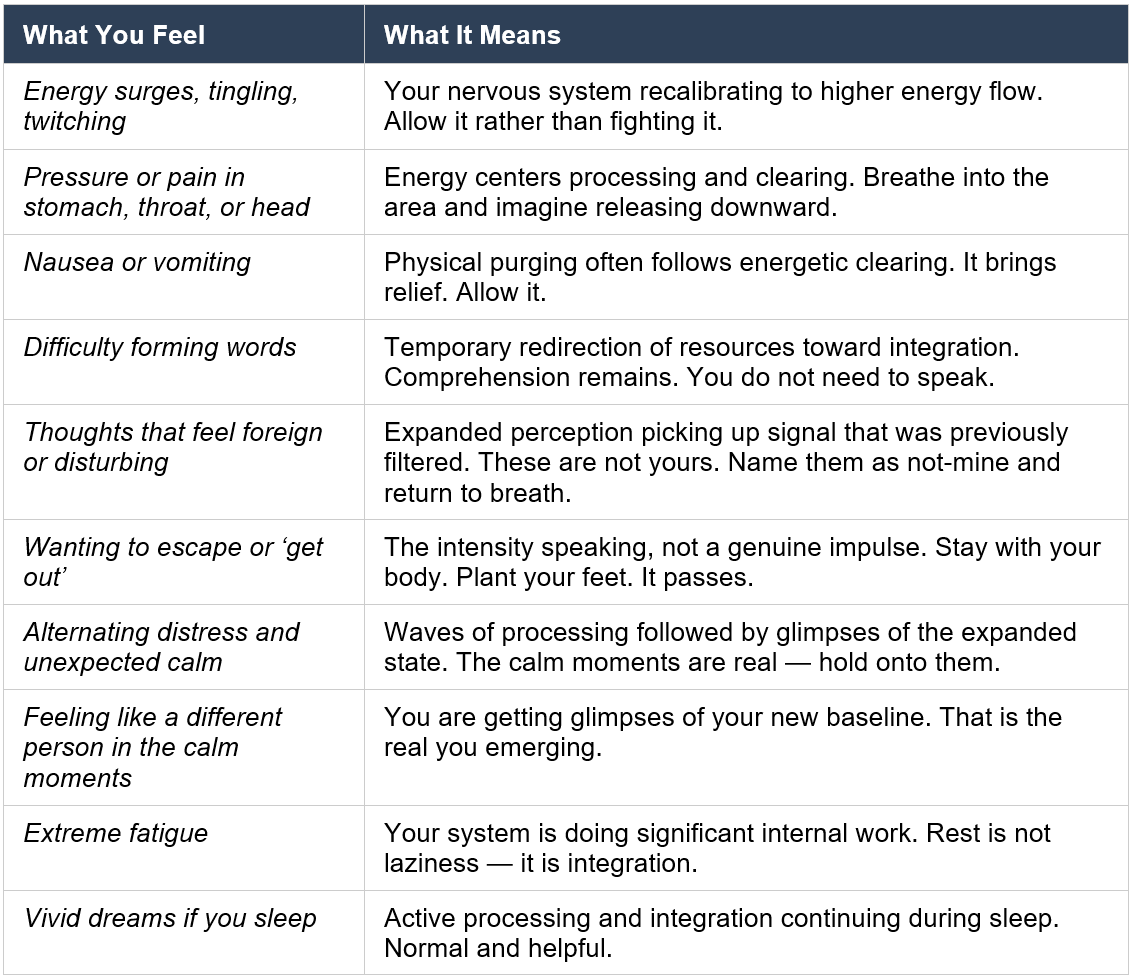
What You Might Experience
All of This Is Normal:
When to Seek Medical Care
Seek immediate medical attention if you experience:
Fever above 38.5°C / 101°F
Severe pain concentrated in one specific location that could indicate an injury rather than ‘energy.’
Genuine difficulty breathing, beyond chest sensations or panic symptoms
Loss of consciousness or near-fainting
Sustained vomiting with no periods of relief over several hours
Any symptom your gut tells you requires medical attention
Seeking medical care does not mean that what you are experiencing is not real. Both things can be true. Taking care of your body is part of the process.
After the First 24 Hours
Once the acute phase has passed or has been significantly reduced, your priority is integration. Your system has done significant work and needs time to settle.
Rest more than you think you need to. Sleep when your body asks.
Eat simply and lightly. Your digestion may be sensitive for a day or two.
Stay hydrated. Add electrolytes if available.
Limit demands on yourself. This is not the time for major decisions or heavy obligations.
Write down what you experienced while it is still fresh, even rough notes. You will want this record.
Be patient with yourself. You may feel different than before. That is real, and it takes time to integrate.
Reach out for support if you need it. You do not have to process this alone.
When you need something to hold onto:
“This is not a threat. My body knows what to do.
This will pass.
I am not alone. What remains will be more of who I really am.”
