Reassurance for Partners: They aren’t going crazy.
A Guide for Partners and Family Members Who May Be Worried about Their Loved One
Something has changed in someone you love. And it is making you worry.
Maybe they have started talking about things that sound strange to you: energy, guides, consciousness, a sense that something big is coming. Maybe their priorities have shifted in ways that seem sudden or irrational. Maybe they seem different, more intense, more inward, less interested in things they used to care about.
You might be wondering:
• Is this a mental health crisis?
• Are they being influenced by a cult or dangerous ideology?
• Is this a breakdown from stress or grief?
• Should I be more worried than I am?
• How do I talk to them without making things worse?
• Will I lose them to this?
These are reasonable questions. This guide will address them honestly, without asking you to simply accept what you don’t understand, and without dismissing the real changes you are observing.
Firstly, Your Concern Is Valid
You are not overreacting by being concerned. When someone we love changes in ways we do not understand, concern is a natural and appropriate response. It comes from caring about them.
At the same time, concern can sometimes lead us toward responses that make things harder rather than easier, particularly when we are dealing with something outside our existing frameworks.
The goal of this guide is to give you a clearer picture of what may actually be happening, so that your concern can be directed where it genuinely helps rather than potentially creating additional friction.
What Is Actually Happening
What your loved one is going through is called an Awakening or Expansion: a significant shift in how they perceive themselves, the world, and their place in it. It is happening to increasing numbers of people across all backgrounds, ages, and belief systems.
This is not a new phenomenon. Throughout history, people have described experiences of expanded awareness, heightened intuition, a sense of deeper purpose, and perception of things beyond ordinary sensory range. What is new is the scale at which it is occurring.
An Awakening involves real changes in how a person thinks, what they value, how they perceive their environment, and, sometimes, in their physical experience. These changes can look alarming from the outside, particularly when you do not share the framework the person is using to understand them.
The most important thing to understand is this: the changes you are observing are real. They are not delusion, performance, or madness. They are the signs of someone whose awareness is genuinely expanding, and that process, while sometimes difficult, is purposeful.
Is This a Mental Health Crisis?
This is the most important question to address, because this is a genuine concern with real implications. Genuine Awakening experiences can superficially resemble certain mental health conditions, which is why this confusion is common. But there are meaningful differences that matter.
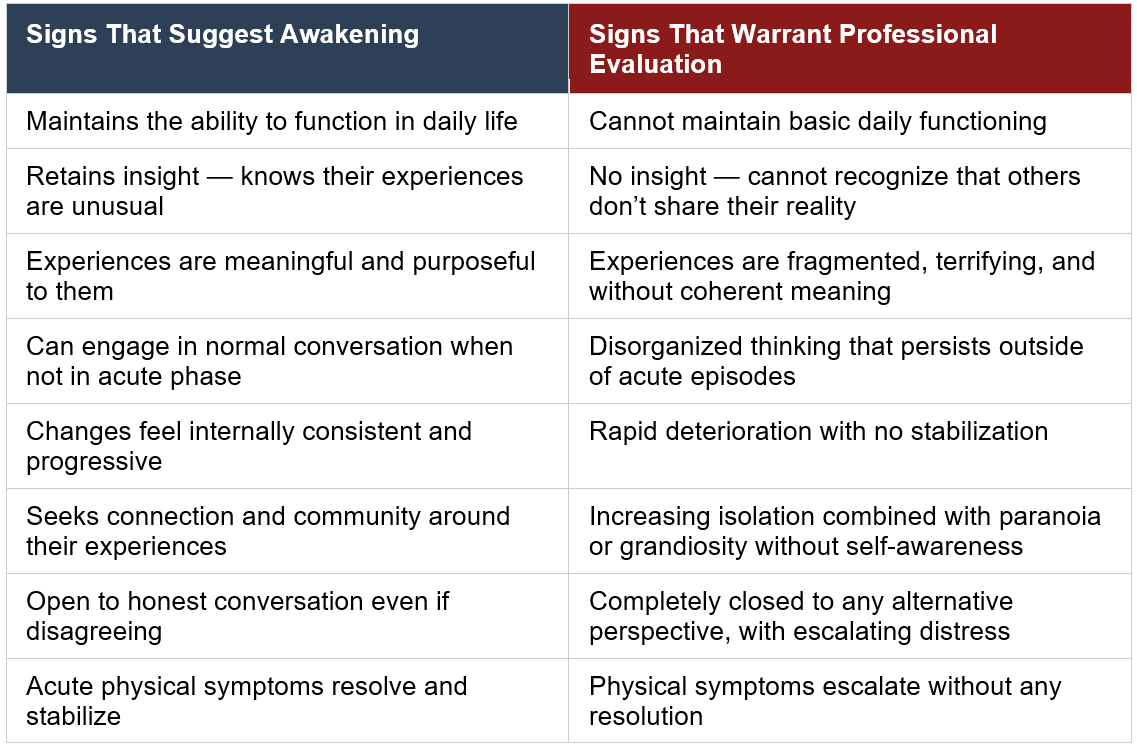
If the right column describes what you are observing (persistent deterioration, loss of basic functioning, complete loss of insight, or escalating paranoia), then professional evaluation is genuinely warranted, and this guide is not sufficient on its own. If the left column is closer to what you are seeing, what your loved one is going through is more likely an Awakening than a mental health crisis.
Is This a Cult or Dangerous Influence?
This is another reasonable concern, because there absolutely are negative outside influences that people fall for.
Genuine Awakening experiences are characterized by greater personal sovereignty and self-trust, not by increased dependence on an external authority. If what your loved one is going through is authentic, it should be making them more themselves, not less. More grounded in their own values, not more controlled by someone else’s.
Healthy signs to look for:
They are making their own decisions and applying their own discernment
They maintain relationships and do not isolate themselves entirely from people who disagree with them
They do not require financial exploitation or demand loyalty from others
They hold their beliefs with curiosity rather than rigid certainty
They are becoming more compassionate and self-aware, not more fearful or controlled
They can engage honestly with questions and disagreement without becoming hostile
Instead of being afraid of the future and belligerent toward institutions, they are optimistic about what the future holds
Warning signs of genuine concern:
They are surrendering decision-making entirely to an external person or group
They are being asked to cut off family and friends who question the framework
There is financial exploitation or significant financial pressure
They are becoming more fearful, controlled, or dependent rather than more self-directed
They are being told that questioning or doubt is dangerous or forbidden
Authentic Awakening moves toward greater freedom and self-trust. Exploitation moves toward greater dependence and control. These are meaningfully different trajectories.
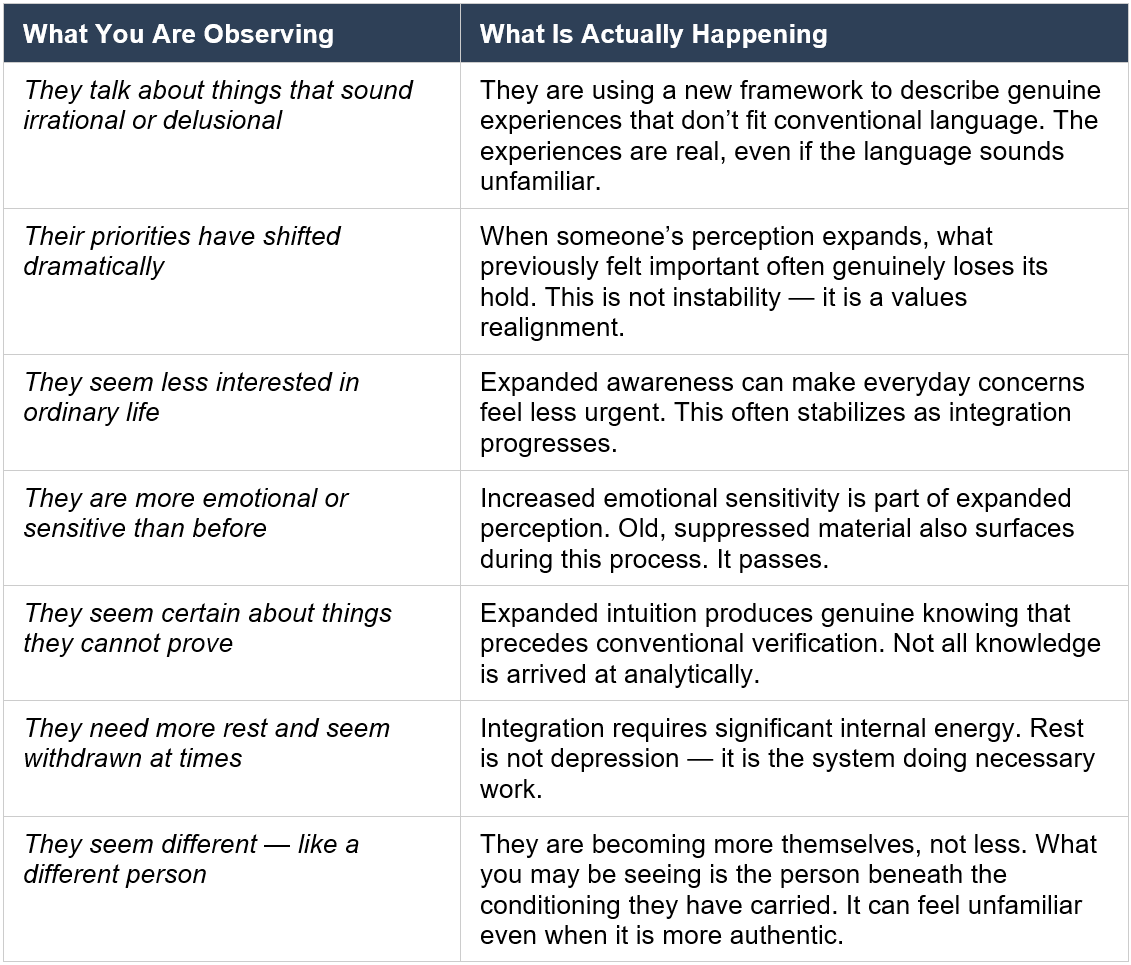
Understanding the Changes You Are Seeing
Many of the changes that feel alarming from the outside have straightforward explanations once you understand what is happening internally.
What This Means for Your Relationship
When one person in a close relationship goes through a significant change, and the other does not, or does not yet, it creates real friction. Rather than the friction being an indicator that your relationship is failing, it’s simply a sign that it is being asked to grow.
The most common dynamic is this: the person going through the Awakening feels increasingly seen and known in their inner world, and increasingly frustrated that the people closest to them cannot yet share that. The partner or family member feels increasingly left behind, confused, and perhaps threatened by changes they did not ask for.
Both experiences are real. Both deserve acknowledgment. The path forward doesn’t come from one person convincing the other; it is both people staying in a genuine relationship while navigating something unfamiliar. Everyone experiences their awakening when it is their time. Not earlier, not later, and it cannot come by force. If your partner is on this path, and you aren’t yet, there is nothing wrong with either of you.
How to Talk to Them Without Making It Worse
How you engage with your loved one during this time matters enormously. The approaches that feel most natural, such as trying to reason them out of it, expressing alarm, and pushing for them to see a professional, often backfire because they communicate that you believe something is wrong with them rather than happening to them.
What tends to help:
Lead with curiosity rather than concern. “Can you help me understand what you’re experiencing?” opens more than “I’m worried about you.”
Acknowledge what you observe without labeling it. “I can see something significant is happening for you” rather than “I think you’re having a breakdown.”
Stay in the relationship rather than the argument. You do not have to agree with their framework to remain close to them.
Ask what they need from you. Do not assume. Sometimes they need space. Sometimes they need presence. Ask.
Share your own experience honestly and without blame. “I’m finding this hard to understand, and I’m worried about you” is more connective than “This is crazy and you need help.”
Find the places you agree. You may not share their framework, but you likely share their values: care for family, a desire for meaning, and a desire to live with integrity. Start there.
Trust the relationship. If it was strong before, it can hold this.
What tends to make it harder:
Telling them directly or implying that what they are experiencing is not real
Repeated insistence that they seek psychiatric help when they are functioning and not in a genuine crisis
Expressing contempt or ridicule for their beliefs, even subtly
Making them choose between their experience and the relationship
Enlisting others to “talk sense” into them without their knowledge
Treating every difficult moment as confirmation that they are unwell
Taking Care of Yourself
Living with someone who is going through a significant change is genuinely difficult, especially when you do not share the framework they are using. Your needs in this matter, too.
Find someone you trust to talk to about your own experience, whether a friend, a counselor, or a community that understands this dynamic.
Distinguish between what is genuinely concerning and what is simply unfamiliar. Not all discomfort is a warning signal.
Maintain your own routines, interests, and relationships. You do not have to put your life on hold while they integrate.
Give yourself permission to not understand everything. You do not have to resolve the uncertainty to remain present.
If the relationship is creating genuine harm, such as emotional, financial, or physical harm, that is a different conversation, and you deserve support in navigating it.
Will I Lose Them to This?
This is often the deepest fear underneath everything else. The honest answer is: it depends less on what they are going through and more on how you both navigate it.
People who go through genuine Awakenings typically become more capable of depth, authenticity, and real connection — not less. If anything, what they are moving toward is a greater capacity for the kind of relationship most people deeply want.
What can drive a wedge is not the Awakening itself but the response to it. When one person feels consistently dismissed, ridiculed, or pathologized for what they are experiencing, distance grows. When both people choose to remain in genuine contact, even without full understanding, the relationship can grow through this.
You do not have to believe everything they believe. You only have to keep choosing them.
They have not lost their mind.
They are finding something they did not know they had lost.
And your willingness to stay curious rather than certain may be the most loving thing you can offer right now.
